MAJ. JAMES J. WILSON
UNITED STATES ARMY (RET)
WWII and Korean WAR VETERAN
COMBAT INFANTRY BADGE
BRONZE STAR
PURPLE HEART MEDAL
ARMY COMMENDATION MEDAL,
with/OLCPRISONER OF WAR MEDAL
AMERICAN DEFENSE SERVICE MEDAL, WWII
AMERICAN CAMPAIGN MEDAL, WWII
EUROPEAN-AFTRICAN-MIDDLE EASTERN CAMPAIGN MEDAL,
with/3 BS and Arrowhead deviceWORLD WAR II VICTORY MEDAL
WWII ARMY OF OCCUPATION MEDAL
NATIONAL DEFENSE MEDAL
KOREAN SERVICE MEDAL
ROK REPUBLIC OF KOREA MEDAL
KOREAN PRESIDENTIAL UNIT CITATION
DISTINGUISHED UNIT CITATION, WWII
MERITORIOUS UNIT CITATION, WWII
FRENCH/BELGIAN FOURAGIERRE
DUTCH MILITARY ORDER OF WILLIAM MEDAL
EXPERT:
45 CAL PISTOLAIRBONE PARACHUTIST BADGE,
with Combat Jump BSOVERSEAS SERVICE BARS
: 5WORLD WAR II BATTLES
: NORMANDY NORTHERN FRANC E RHINELANDWORLD WAR II UNIT: Platoon Leader, 505th Parachute Infantry, 82nd AIRBORNE DIVISION (participated in the invasion of Europe, jumping with the 82nd at Normandy and subsequently captured as a POW.)
ARMY SERVICE SCHOOLS
Tank Destroyer Officer Candidate School
Airborne Jump School
Infantry Officer Advanced Course
AG Officer Career
Military Asst. Institute
TOTAL MILITARY SERVICE: 20 YRS, 9 MON, 25 DAYS
CHILDREN: Anne, Jim, and Susan
BURIED: Fort Benning Federal Cemetery with his wife
AnneD-DAY
The largest combined military operation in history "D-Day" was to be spearheaded by the 82d and 101st Airborne Divisions. Visibility was hampered by poor weather conditions as the C-47's crossed the English Channel during the first hours of the 6th of June 1944. When the troop carriers finally did made landfall on the Cherbourg Peninsula they came under heavy German flak scattering many of the troop carrier flights. It was 0300 hours on 6 June 1944, when the 505th were given the green light to jump. Some
Pathfinders were able to signal their drop zones. However, many of the troop carriers missed their drop zones and the All-Americans of the 505th began landing across a large swath of the countryside around Normandy.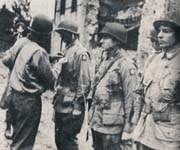
Nevertheless, the 505th PIR was one of the first airborne units to hit the ground and despite the subsequent confusion surrounding the landing, were able to use it to their advantage mustering enough troops under the command of the 2nd Battalion Commander, Lt. Col. Benjamin Vandervoort to liberate the first town in France, -
St. Mere-Eglise. The paratroopers jumped prior to the actual start of the invasion "H-Hour". Because of the tradition of being the first into the fight, the 505th Regimental motto is "H-MINUS". For their performance in the invasions the 505th was awarded the Presidential unit citation, the unit equivalent of the Medal of Honor awarded to individual soldiers. In the words of author Clay Blair, the paratroopers emerged from Normandy with the reputation of being a pack of jackals, the toughest, most resourceful and bloodthirsty in Europe.On 9 September 1944 Field-Marshal Montgomery proposed a plan, called Operation Market Garden, to secure a bridgegehead across the Rhine. The operation called for a combined armor and airborne assault to seize and hold key bridges and roads deep behind German lines in Holland. The airborne phase of the operation consisted of capturing five bridges ahead of the armored force.
Despite a lack of cold weather equipment once again airborne spirit, courage, and hard-nosed determination won the day as the 505th withstood the bleak winter and stopped the fanatic German attacks at Ste Vith and the Salm River.
For its valor in the seven major campaigns of the European Theatre of Operations, the 505th was awarded two Distinguished Unit Citations and three Foreign decorations: the French Forragere, Netherlands Military Order of William, and Belgium Forragere.
Occupation
The war offically ended in Europe on 5 May 1945 and the 82nd Airborne Division was called upon to serve as the occupation force in the American Sector of Berlin. Here the 82nd Airborne Division earned the name, "America’s Guard of Honor," as a fitting end to hostilities in which the "All-Americans" had chased the German Army some 14,000 miles across the European Theater.